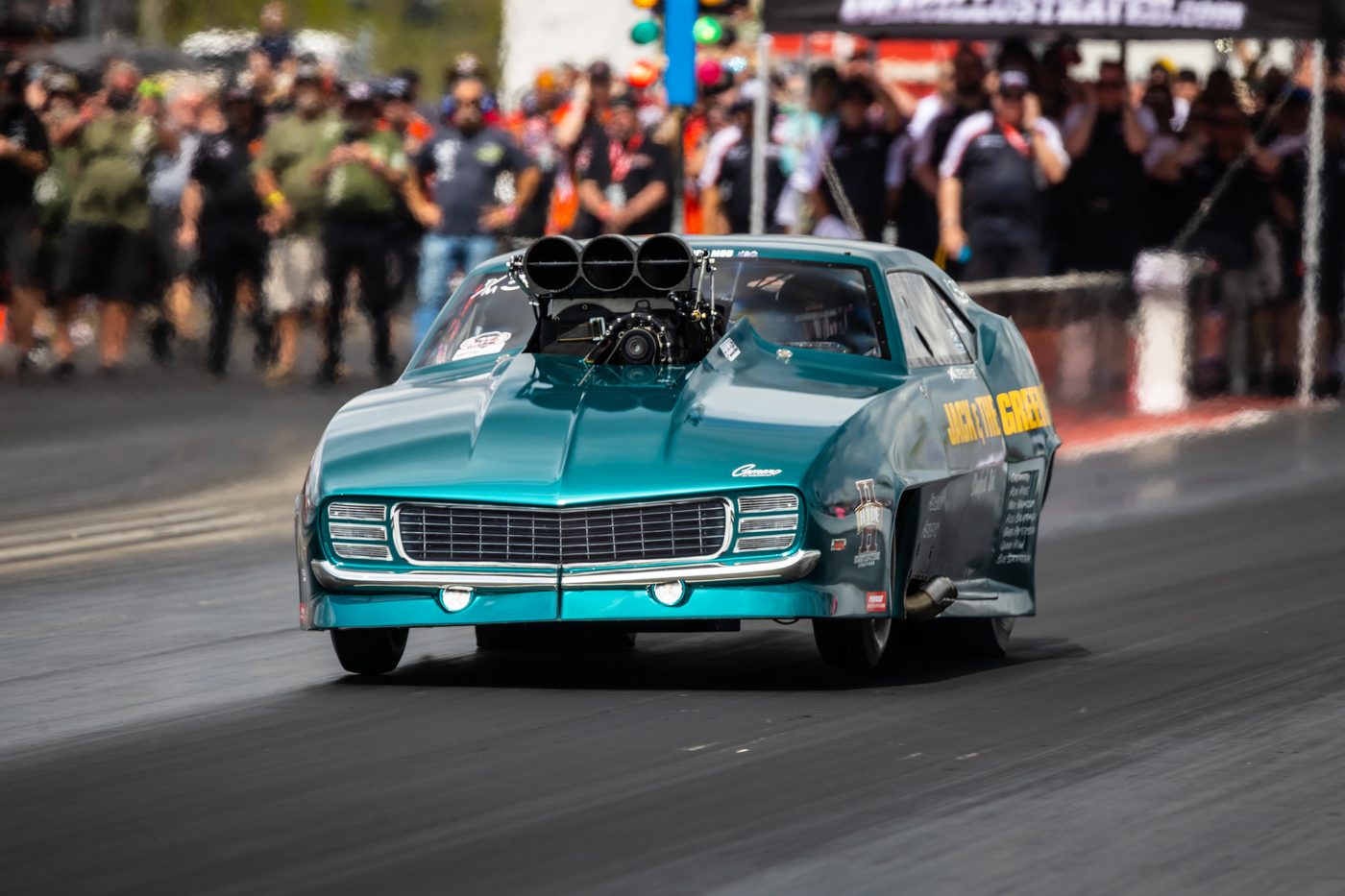
Photo: Wayne Stewart
Pro Mod History
RUN WHATCHA BRUNG
Pro Modified is the only professional class in drag racing that was invented by the racers instead of the sanctioning body. It has no single founder, no clean origin date, and no agreed-upon first hero. What it has instead is about forty years of people building whatever they wanted, going faster than anybody expected, and daring the rulebook to catch up.
That is still the appeal. It is why Wes Buck calls it the universal language of drag racing, and why almost every racer in every other category will admit, if pressed, that Pro Mod is the class they would run if money were no object.
Here is where it came from.
The Ancestors
Long before anybody said the words, the shape of the thing existed. In March 1964 Dodge dropped supercharged dragster engines into lightly customized new super stockers and sent them out on tour as the Dodge Chargers. Mercury answered with a Bill Stroppe-built 1964 Comet for Jack Chrisman running a blown fuel 427. When General Motors walked away from racing in 1963, GM racers chasing match race money adopted the same formula: put the dragster engine in the door car and get paid.
“Ohio George” Montgomery put a stretched Willys frame under a 1967 Mustang body with a blown SOHC 427, then built a twin-turbocharged Boss 429 Mustang that ran 8.22 at 173.75 before he parked it in 1975. Bill “Grumpy” Jenkins built a tube-frame Vega in 1972 and, by 1974, had thrown out the stock front suspension in favor of MacPherson struts, setting the basic architecture that extreme door cars still use.
Meanwhile a handful of engine builders were making horsepower entirely outside NHRA’s displacement limits. Sonny Leonard in Lynchburg, Virginia. Jon Kaase in Winder, Georgia. Scott Shafiroff in New York. The mountain motor existed because somebody said it could not.
Three Different Beginnings
Ask ten people when Pro Mod actually started and you will get at least three answers, all defensible.
1981. Jack Weller fielded a blown 1959 Corvette called Proud American, driven by former nitro Funny Car pilot R.C. Sherman. Historian Bret Kepner points to this as the true starting point.
Fall 1983. Charles Carpenter bolted nitrous oxide to his all-steel 1955 Chevy and ran an 8.3. The same car had run 10.50 two years earlier. Many people inside the class consider this the moment.
1987. Bill Kuhlmann went 202 miles an hour in a door car, and the argument was effectively over.
Meanwhile, On The West Coast
The East Coast version of this story is the one usually told, but California was running fast door cars first. In 1971, promoter Dave Dorman staged a Pro Gas event at Redding Dragway featuring Northern California hitters Dave Riolo, Bob Bunker, Tom Thornhill and Wayne Torkelson. He had booked them earlier as an eight-car, no-breakout show and called them Pro Gas for a reason he never dressed up: “I could only afford gassers.”
Riolo ran a big engine with nitrous. Bunker ran a supercharger. The rivalry that produced was the West Coast’s version of the same argument the class is still having today.
It also produced one of the great forgotten races in drag racing, a coast-to-coast sprint to put a 1955 Chevy into the sevens, driven largely by the magazines. Carpenter got there first at Richmond Dragway with a 7.99. Riolo took the quickest title back with a 7.97 at Fremont. By the accounting of the people who were there, Carpenter beat him by about three hours.
“I always had to remind them that those guys on the east coast might talk a little funny but when it comes to their cars, they will beat you with a stick.”
Mike Thermos, founder of NOS
The Quick Eight
The class was really born in the staging lanes of eighth-mile tracks in the Carolinas. Promoters around Charlotte and Orangeburg were booking IHRA mountain motor Pro Stockers and Alcohol Funny Cars as the draw, and the local door cars kept outrunning them. So the promoters started paying the local cars to leave bracket racing and match race instead.
That became the Quick Eight: the eight quickest doorslammers after Saturday qualifying, racing for money on Saturday night. Depending on who you ask, the first one happened at Shuffletown Dragway in Charlotte or at Orangeburg Dragway in South Carolina. Ed Hoover, a diesel repair shop owner from Columbia, South Carolina, won the first one at Shuffletown.
When Billy Meyer bought the IHRA he rebuilt Pro Stock and eliminated class racing in the sportsman ranks, but he left Top Sportsman alone. Kepner believes four cars talked him out of it: Bill Kuhlmann’s Camaro, Robbie Vandergriff’s 1957 Chevy, Charles Carpenter’s 1955 Chevy and Richard Earle’s 1958 Plymouth Fury, a near-perfect replica of the car from Christine.
Meyer asked Kuhlmann the obvious question. How do you propose to race a class with no rules?
“You run whatcha brung and hope ya brung enough.”
Bill Kuhlmann
“Animal” Jim Feurer won the first IHRA Quick Eight at the 1988 Winternationals in Darlington, driving a Mercury Zephyr he had previously raced in AHRA Pro Stock. The purse, by his own account, was about $1,500, and none of it came from the IHRA. Mike Thermos and contingency money paid for it.
Feurer’s car had to be push-started by his crew, a race official and Ron Colson. After the win he sat stranded at the top end and heard a roar go up behind him. The officials had walked onto the track to inspect his tire tracks for a center-line violation, and the crowd had followed them out. When they pointed at his lane, the place erupted. That was the night everybody realized what they had.
The Barriers
On March 14, 1987, at 7:44 in the evening, at the IHRA Winternationals in Darlington, Bill Kuhlmann ran 202 miles an hour in a door car. He was, until that moment, an obscure low-buck UDRA Pro Stock racer. As Kepner put it, the only people who really knew of Bill Kuhlmann were the people who went to UDRA races, and that was not a lot of people. The following year he landed Summit Racing Equipment.
Everybody had assumed the six-second run would fall first. It did not. Roughly fifteen months after Kuhlmann’s 202, Tommy “The Who” Howes ran a 6.99 at 201 in a supercharged Datsun 300ZX, becoming the first door car driver to break into the sixes and clear 200 in the same pass.
His peers did not take it well. The blower stuck through the hood, the suspension was solid, and a lot of people felt what he had was a Funny Car with doors. NOS had posted $5,000 for the first six-second door car. Howes never got paid.
“They refused to pay me they were so bent out of shape.”
Tommy Howes
Naming It
Late one night during the 1989 IHRA Fall Nationals at Bristol, announcers Bret Kepner and Ed O’Reilly sat in the tower with IHRA vice president Ted Jones and worked out what to call the thing. IHRA already had a stock branch that ran Stock to Super Stock to Pro Stock. It had the indexed ROD divisions. And it had Modified, which had never been extended into the professional ranks. Modified and Factory Modified already existed in the sportsman classes.
Pro Modified was the obvious extension. Pro Stalgia, Pro Nostalgia and Pro Outlaw were all considered and discarded. Drag Review even ran a name-the-class competition. Kepner’s name won.
Atco, October 1989
The first cars to carry the designation ran at Atco Dragway in New Jersey on October 28 and 29, 1989, as a 16-car exhibition inside an IHRA points event. No championship points were at stake. The winner got $4,000 and the right to carry the number 1 for the inaugural season. The flyer just called it Pro 16.
Bill Kuhlmann won it, beating Gordy Hmiel in Scott Shafiroff’s Over the Hill Gang Pontiac. His reign as number 1 lasted about a race. Under pressure from the other competitors, Ted Jones made him change the number on his windshield to 1000.
The weekend also cost the class one of its own. Walter Henry, a Baltimore native living in Huntersville, North Carolina, and one of the leading advocates for the supercharged combination, was fatally injured during an elimination run when his Corvette got a tire into the grass, crossed the lanes on the recovery and struck a scoreboard beam. Witnesses have never agreed on whether it was a mechanical failure or a driver who would not lift. They agree on everything else about it.
Henry was a decorated Vietnam veteran who flew two tours as a helicopter pilot with the 7th Air Cavalry. Atco was to have been his last race. He was retiring, and his son Gary was to begin licensing shortly afterward.
Darlington, March 1990
Pro Modified became an official professional eliminator at the IHRA Winternationals in Darlington, South Carolina, in March 1990. Ed Hoover, the man who had won that first Quick Eight at Shuffletown, won the first national event. Mike Ashley qualified number one. Tim McAmis, a future world champion, went to the final and broke on the starting line. Ronnie Sox, “Mr. Four Speed” himself, came out of retirement to run a 707-cubic-inch Boss Ford in a caricature of a 1964 Comet, qualified 16th, and won the first round.
The rulebook fit on a page or two. Nitrous engines were capped at 710 cubic inches, supercharged alcohol engines at 526. Full suspension required. Approved wing or spoiler. Engine setback no more than ten percent.
Not everybody inside the building wanted it.
“I caught the biggest hell from Jim Ruth, the IHRA President. He went nuts after Fred Hahn and Jim Oddy ran that 6.69. All of a sudden that run made the Pro Stockers look slow.”
Ted Jones, IHRA vice president
What The Magazines Did
It is impossible to separate the rise of Pro Mod from the press that covered it. Through the 1980s, Super Stock & Drag Illustrated and Petersen’s Drag Racing put these cars on covers that had previously belonged to Pro Stockers. The magazines tracked the race to the first six and the first 200 like a heavyweight title fight. R.C. Sherman’s arrival went largely unremarked, but when a part-time journalist named Dave Bishop called Charles Carpenter’s car the World’s Fastest 1955 Chevy, every other racer in the country wanted a title of his own.
“The media was the key to our survival and growth. That media hype and exposure fueled the fire. There wasn’t an internet and those magazines were the only connection we had to the race fans and industry.”
Charles Carpenter
Carpenter ran 53 races and match races in 1988 alone. “At times we were racing as many as three different times a weekend at three different places,” he said. “We were zig-zagging the country as much as humanly possible.”
The Eras That Followed
Scotty Cannon came out of Top Sportsman with a 1941 Willys replica and a mohawk and won six Pro Modified championships, taking 28 national event wins before leaving after the 1998 season to chase a fuel Funny Car ride. He remains the winningest driver in IHRA Pro Mod history, and in 2007 he tuned his son to the championship.
Pro Mod was born and raised in the IHRA. It did not stay there. ADRL built an entire touring series around big-money door car racing in the 2000s. The PDRA carried it forward. NHRA brought Pro Mod into its national event program, and the modern landscape now includes 39 Pro Mod races a year across five sanctioning bodies with rules that do not match.
The technology moved with it. The screw blower, adapted from an industrial Lysholm compressor by aerospace engineer Norm Drazy at PSI in 1988, was so dominant on arrival that NHRA placed a moratorium on it while it worked out how to regulate it. For three decades nobody seriously believed a centrifugal supercharger could out-power a C-rotor screw on a Hemi. That assumption collapsed in the last few years, and the argument it started is the loudest one in the class today.
Right Now
Pro Mod is in the best shape it has ever been in. The quickest cars run in the 3.40s over an eighth-mile with 4,000 horsepower and sixty-foot times under .890. PDRA series director Tyler Crossnoe puts the number of cars capable of winning any given race at more than 75. There is no clear favorite anymore, which is precisely why people watch.
“Years ago, there were the ‘favorites’ who you kind of knew would win before the race ever started. Now, you have 75-plus cars in the country that could win any event they attend.”
Tyler Crossnoe, PDRA
Shawn “Murder Nova” Ellington, one of several Street Outlaws names who came into the class and stayed, puts his finger on why it travels: “They’re relatable to people because they’re door cars. You can look at a 1969 Camaro and go, okay, that’s a ’69 Camaro. It still looks like a real car.”
Scott Taylor is blunter about it. “You take 4,000-plus horsepower and stick it in a door car. To me, it doesn’t get any more exciting than that.”
“We had 85 cars at the Snowbird Outlaw Nationals, 75 at the U.S. Street Nationals and 65 at the World Series of Pro Mod. Seventy-five cars a race, chasing 32 spots.”
Wes Buck
At the 2026 U.S. Street Nationals, every one of the 32 qualifiers ran in the 3.50s. It was the quickest Pro Modified field ever assembled, and roughly forty cars went home.
That is the part people outside the class miss. In Pro Mod right now, qualifying is the hard part. Winning is what happens after you have already beaten half the entry list in the parking lot.
The Industry Behind It
The clearest evidence that this is a real boom and not a good season is what is happening in the shops. Chelsea Hord of Jerry Bickel Race Cars in Moscow Mills, Missouri, points at the rulebook as the reason.
“The majority of the classes are so choked on all these rules, and it’s all the same motors, the same power adders, the same weight. You don’t have much creativity. But with Pro Mod it’s extremely diverse. It’s the most agile class that I can think of.”
Chelsea Hord, Jerry Bickel Race Cars
Dozens of body styles. Five different power adders. Clutch or converter, your choice. “You can do so much more with Pro Mod,” Hord said. “You can try different things. You can push the limits.”
Wes Buck recently spoke with a chassis builder who told him his company could not keep up with demand for Pro Mod chassis even if it tripled production.
“It basically tells me that there’s an entire world of manufacturers who should be paying attention to what is happening here and looking for problems to solve.”
Wes Buck
New builders are moving in on that math. Precision Built Race Cars in Brownsburg, Indiana, has entered the segment. Keith Haney has partnered with KB Titan Racing to form KBT Pro Mod, an arrive-and-drive operation planning eleven leasable cars for the NHRA Pro Mod Series, the Drag Illustrated Winter Series and one-off events. Buck’s summary of what he hears from the trade: “the word that I hear from chassis shops and engine builders around the country is that Pro Mod is what keeps them busy.”
The calendar has grown with it. NHRA expanded its Pro Mod series to eleven events for 2026 and remains the only organization still running the class over a quarter-mile. PDRA runs seven, splitting the category into Pro Nitrous and Pro Boost to hold parity closer. The Mid-West Drag Racing Series, which Haney founded in 2017, averaged 21 Pro Mods per event last season.
What It Is Replacing
There is a version of this story where Pro Mod is not a new thing at all, but the return of an old one. Hord makes that argument directly.
“We believe Pro Mod racing is replacing the old-school Saturday night booked-in match racing. It’s going to be similar to an exhibition class that brings people in. There’s opportunity for promoters.”
Chelsea Hord, Jerry Bickel Race Cars
Which brings the whole thing full circle. Pro Mod was born in the match race scene, out of promoters in the Carolinas paying local door cars to stop bracket racing and start putting on a show. Forty years later, the class that grew out of booked-in Saturday nights is the one filling that hole in the calendar.
The Money Caught Up
When Drag Illustrated announced the World Series of Pro Mod in 2017, the biggest Pro Mod races in the country were paying $7,000 to $10,000 to win. The World Series opened at $100,000, winner take all.
“This was absolutely unheard of. We basically introduced this invitational format, big money, crazy, over-the-top, pomp and circumstance, a level of production value that the sport of drag racing hadn’t previously seen.”
Wes Buck
In 2027 the World Series of Pro Mod moves to Texas Motorplex in Ennis, Texas, standing alone as a single crown jewel event for the first time since the Bandimere years.
Pro Mod raced for $100,000 to win in 2017. Forty years earlier the class was fighting over a $1,500 purse that the sanctioning body did not put up.
The pandemic stopped it in 2020 and gave the team time to reimagine it. It returned at Bradenton Motorsports Park in 2023. “The event kind of took on a new life in Florida and caught fire,” Buck said. “It was almost unbelievable. The fact that we had taken a few years off, but we were able to really pick up right where we left off and then some.”
“If drag racing had a best foot to put forward right now, in my opinion, it’s undoubtedly Pro Modified.”
Wes Buck
And in 2027 the World Series of Pro Mod deliberately goes the other direction. Standing alone as a single crown jewel event rather than the finale of a three-race series, it will drill down on exclusivity to a level the race has not applied since the Bandimere years. Bigger is not the only way to grow something. Harder to get into is the other one.
Forty years on, the class still runs on the same principle it was founded on. Bring what you have. Hope it is enough.
The next chapter gets written March 5-7, 2027 at Texas Motorplex. See every World Series of Pro Mod champion on the Champions page, or read the story of how this race was built.
Sources: Bobby Bennett, Pro Modified: Two Decades of Thrills (CompetitionPlus, four parts) and Pro Modified on the West Coast; John Gatliff and Thom Taylor for HotRod; Meredith Kaplan Burns, The Power Behind Pro Mod Mania (PRI Magazine, January/February 2026). Where accounts conflict, we have said so rather than choose. Corrections are welcome and will be credited.